Technical Overview
In bigraphs, the dynamic behavior of a system under observation is rooted in process algebra (see [2], [3]) and represented by means of reactions written  , where
  denote the system states before and after the application of the reaction rule R.
This rewriting formalism induces an observational semantics, where the meaning of a system is characterized by the observable transitions between bigraphical states.
Generally, a state is a bigraphical snapshot of the system at a specific point in time.
Such a state may represent the system at a level of abstraction and fidelity appropriate for the modelling or analysis task under consideration.
denote the system states before and after the application of the reaction rule R.
This rewriting formalism induces an observational semantics, where the meaning of a system is characterized by the observable transitions between bigraphical states.
Generally, a state is a bigraphical snapshot of the system at a specific point in time.
Such a state may represent the system at a level of abstraction and fidelity appropriate for the modelling or analysis task under consideration.
Founded on the categorical semantics of bigraph theory (see [1]), this reaction formalism together with the underlying bigraph structure enables the specification and execution of dynamic systems (e.g., simulation or formal verification) within a uniform mathematical framework:
A Bigraphical Reactive System (BRS) acts as an executable system specification that combines the structural representation of a system with its dynamic evolution semantics. Conceptually, a BRS encapsulates:
- the signature, defining the types and constraints,
- the initial state, and
- the reaction rules, specifying how the system may evolve over time.
The following sections provide a technical overview of BRS construction, the anatomy of reaction rules, and the main classes governing the evolution of bigraphs (i.e., system states), before these topics are explained in greater detail in the subsequent sections.
Refer to Verification to get to know more about how to use a BRS specification for model checking.
Refer to the Usage Example, which describes a complete procedure on how to practically use bigraph matching and rewriting in Bigraph Framework.
An overview of the most important classes is also listed on this page in section Changing Bigraphs over Time: Overview.
Bigraphical Reactive System (BRS)
A BRS is a model of a system or system specification containing an initial host bigraph and a collection of reaction rules.
In category-theoretic terms, BRSs are defined as syntactical categories endowed with a set of reaction rules.
Specifically, a concrete BRS is a s-category  containing a signature and a set of rules.
All reactive system implementations extend the interface org.bigraphs.framework.core.reactivesystem.ReactiveSystem<B extends Bigraph<? extends Signature<?>>> of the Core Module in Bigraph Framework.
Creating a BRS by Instantiation
A reactive system for pure bigraphs can be created by calling its constructor as follows:
PureReactiveSystem reactiveSystem = new PureReactiveSystem();
Then, an initial bigraph and reaction rules can be added like this:
// Set the initial agent
PureBigraph agent = ...;
reactiveSystem.setAgent(agent);
// Add a reaction rule
ReactionRule<PureBigraph> rr = ...;
reactiveSystem.addReactionRule(rr);
In the bigraph theory, an agent is any ground bigraph, i.e., a bigraph that has no sites and inner names. It must also be prime, i.e., it must have only one root.
In Bigraph Framework, an agent is generally referred to as a state.
An exception will be thrown if the rules or agent are not in the correct format.
- Predicates as used in model checking for reachability checking can be added using the method
PureReactiveSystem#addPredicate(ReactiveSystemPredicates<B> predicate). - See also here on how to create predicates.
Creating a BRS by Inheritance
Inheriting a reactive system implementation allows for an object-oriented approach to better organize and manage domain-specific BRSs in an application.
The following example defines a BRS that can compute the sum of two integers, which are represented in bigraphs in unary form. In this form the symbol S is used to denote successor, and Z to mean zero. For example, the number 2 would be writing as S.S.Z.
import org.bigraphs.framework.core.reactivesystem.*;
import org.bigraphs.framework.simulation.matching.pure.*;

public class AddExpr extends PureReactiveSystem {

    public AddExpr(int a, int b) throws Exception {
        setAgent(createAgent(a, b));
        addReactionRule(createReactionRule_1());
        addReactionRule(createReactionRule_2());
    }

    // Custom extended method of this reactive system specification that allows execution
    public PureBigraph execute() throws Exception {
        // Instantiate a matcher
        AbstractBigraphMatcher<PureBigraph> matcher = AbstractBigraphMatcher.create(PureBigraph.class);
        // Get the current state
        PureBigraph agentTmp = getAgent();

        // ...
        // apply rules according to some strategy or randomly
        // ...

        // Return the final state
        return agentTmp;
    }
}
The concrete methods AddExpr#createAgent(), AddExpr#createReactionRule_1() and AddExpr#createReactionRule_2() are omitted in this example for clarity.
Anatomy of Reaction Rules
BRS introduce a time-varying notion to bigraphs through reaction rules. That is, reaction rules enable some kind of simulation of system states, which internally is enabled by means of graph rewriting. The bigraph rewriting formalism allows to synthesize a (potentially infinite) labelled transition system (LTS). Each node of the LTS is a bigraph state. States are connected by edges called transition relations labeled with the reaction rule that led to this state. The LTS can have cycles.
To generate an LTS, reaction rules must be applied. A reaction rule comprises a redex and reactum. That is, a rule consists of a left-hand side, and a right-hand side. The meaning of a rule is as follows: The redex specifies the pre-conditions and the reactum the post-conditions. If the redex could be found in some host bigraph, the matched part of the bigraph is replaced by the reactum. This is also called graph rewriting, which solves the subgraph matching problem.
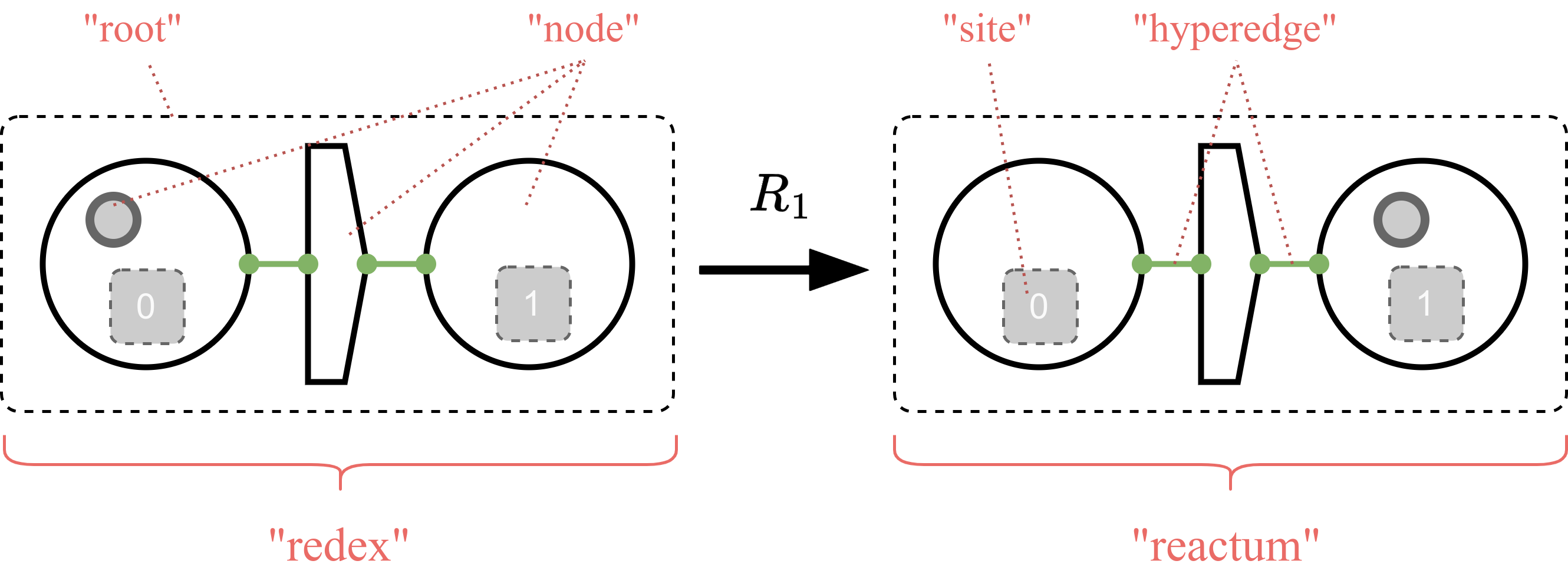 Example of a bigraphical reaction rule comprising a redex (left-hand side) and reactum (right-hand side), which both are bigraphs. The rule describes the movement of the smaller circle from one place to another place (larger circles).
Simulating a BRS works as follows: Beginning with a bigraph (i.e., the initial state of the BRS), a set of reaction rules is applied as long as a match can be found, or until some stopping criteria eventuates (such as time, number of states explored, any convergence criteria, etc.). Note that the bigraph and the reaction rules need to be defined over the same signature.
Sometimes a rule can have multiple occurrences in a host graph. Thus, rules are often non-deterministic.
Refer to section Reaction Rules, which explains bigraphical reaction rules in more detail.
Bigraphical reaction rules enable a form of the more general rule-based programming paradigm. Therefore, you can use advanced rule strategies to control the execution order of rules.
Changing Bigraphs over Time
Having explained the essentials of BRSs until here, the matching and rewriting functionality from the following classes can be used to conveniently execute BRSs in arbitrary ways:
Matching
org.bigraphs.framework.simulation.matching.AbstractBigraphMatcher- This abstract class defines a matcher and needs a host graph and rule to perform bigraph matching.
- A bigraph matcher consists of a bigraph matching engine w.r.t. to the bigraph type.
- The correct one is automatically created using the factory method
#create(Class)by supplying the bigraph class type. - Matches are returned via an iterator (the instances of the matches are of type
BigraphMatch).
Rewriting
org.bigraphs.framework.core.reactivesystem.ReactiveSystem- This interface defines two methods for rewriting after a match was found:
- Implementations of this interface:
- Core Module:
org.bigraphs.framework.core.reactivesystem.AbstractSimpleReactiveSystemis an abstract base class for all reactive systems in Bigraph Framework. - Simulation Module:
org.bigraphs.framework.simulation.matching.pure.PureReactiveSystem(extendsAbstractSimpleReactiveSystem) is a concrete implementation of a reactive system for the class of pure bigraphs.
- Core Module:
References
[1] Milner, Robin: The Space and Motion of Communicating Agents. 1st ed. New York, NY, USA: Cambridge University Press, 2009. ISBN 978-0-521-73833-0.
[2] Bergstra, J.A.; Ponse, A.; Smolka, S.A.: Handbook of Process Algebra. Amsterdam, North-Holland / Elsevier, 2001.
[3] Fokkink W: Introduction to Process Algebra. Springer-Verlag, Berlin Heidelberg, 2000.